
Continuous Access Evaluation: Real-Time Token Security for the Modern Enterprise
Continuous Access Evaluation: Real-Time Token Security for the Modern Enterprise
 Before delving further about Continuous Access Evaluation, let’s take quick discussion at current incidents. A recent industry reports highlight a growing trend: token theft attacks are becoming one of the most common ways adversaries bypass enterprise security. Attackers steal valid access tokens often through phishing, malware, or session hijacking and exploit the fact that these tokens remain valid even after a user’s credentials or permissions have changed. In many cases, organisations only detect the misuse long after the damage is done.
As enterprises expand their digital ecosystems across Microsoft 365, cloud platforms, and hybrid networks, the challenge of securing access becomes increasingly complex. Traditional access controls, which rely on static token lifetimes, are no longer sufficient. Once issued, tokens can remain active for up to an hour even if an account is disabled, a password is reset, or a high-risk sign-in is detected.
For threat actors, that hour provides a critical window of opportunity. For defenders, it’s a dangerous blind spot. This is where Continuous Access Evaluation (CAE) transforms the equation. Instead of depending on time-bound validation, CAE introduces real-time, event-driven enforcement. Access rights are continuously evaluated based on the current state of the user, device, and environment. If a session is compromised, if a user changes location, or if a Conditional Access policy is violated, CAE responds near real-time revoking or challenging access on the spot. The result is a stronger, adaptive security posture that not only prevents token abuse but also safeguards sensitive data without sacrificing productivity.
Overview of Continuous Access Evaluation
Continuous Access Evaluation (CAE) represents a fundamental evolution in identity and access management. Traditionally, access control has been governed by time-bound tokens, typically valid for up to an hour after being issued. While effective in reducing the frequency of authentication prompts, this model introduced a significant security gap: tokens remained valid even if a user’s circumstances had changed. For example, a terminated employee, a user whose password was reset, or someone attempting to log in from a suspicious location could still access corporate resources until the token expired.
The CAE eliminates this gap by introducing an event-driven, real-time approach to access evaluation. Instead of waiting for a token’s natural expiration, CAE-enabled applications and services integrated with Microsoft Entra ID (formerly Azure Active Directory) monitor for critical security events that immediately impact a user’s access rights.
These events include, but are not limited to:
- User Account Status Changes – such as when an account is disabled or deleted.
- Credential Updates – including password resets or Multi-Factor Authentication (MFA) enrolment changes.
- Suspicious Activity – like anomalous sign-ins or access attempts from unrecognised geographies.
- Conditional Access Policy Changes or Violations — when a user logging in from an unexpected place or non-compliant device.
When such an event occurs, CAE ensures that the active session is near real-time reevaluated. If conditions no longer meet the organisation’s policies, access tokens can be revoked within minutes, and the user is required to reauthenticate. This enables security teams to close potential attack windows that could otherwise be exploited.
From an architectural perspective, Continuous Access Evaluation (CAE) integrates directly with Microsoft 365 applications (Exchange Online, SharePoint, Teams), Microsoft Graph, and CAE-capable clients, enabling enterprises to enforce adaptive access controls without compromising the user experience. While access tokens in Entra ID traditionally default to a one-hour lifetime, Microsoft has been evolving these defaults CAE allows for extended lifetimes of up to 28 hours in compliant sessions, balancing security with productivity. It is important to note, however, that the one-hour lifetime is a legacy default; organisations can configure policies differently and relying on the static “one-hour” figure as absolute may cause misunderstanding.
In essence, Continuous Access Evaluation shifts identity protection from being reactive and time-limited to proactive and adaptive. For organisations navigating complex compliance requirements, remote workforces, and evolving cyber threats, CAE provides a critical mechanism to ensure that only the right users, under the right conditions, maintain access to sensitive resources moment by moment.
Key Features of Continuous Access Evaluation (CAE):
-
- Real-Time Access Management
One of CAE’s most powerful capabilities is its ability to respond immediately to critical security events. Traditionally, access tokens remained valid until they expired, leaving a window of vulnerability if a user account was disabled, a password was changed, or a suspicious login occurred. With CAE, that risk is dramatically reduced. Tokens can be revoked within moments often in seconds ensuring that access reflects the organisation’s current security posture, not yesterdays or even last hours. This real-time responsiveness closes the gap that attackers often exploit and gives security teams confidence that controls are always up to date. - Longer Token Lifetimes Without Sacrificing Security
Short-lived tokens that frequently expired every hour were used in the past to strike a balance between user convenience and security, which could irritate users and impair application performance. That equation is altered by CAE. Organizations can safely issue tokens with lifetimes of more than a day since access is continuously validated against live conditions. As a result, there is less need for frequent reauthentication, which enhances end-user experience and application efficiency. However, if risk conditions change, CAE can promptly deny access, eliminating the security trade-off. In actuality, this results in more efficient employee workflows and greater IT teams’ peace of mind. - Event-Driven Architecture
At its core, CAE operates on an event-driven model. Instead of relying solely on timeouts, CAE listens for critical signals from Microsoft Entra. When a triggering event occurs such as a user being disabled, a device falling out of compliance, or a suspicious sign-in being detected the relevant applications are notified almost near real-time. Those applications then act accordingly, either by prompting the user to reauthenticate or by terminating the session altogether. This approach ensures that access rights are always synchronised with the organisation’s security policies in near real time. - Seamless Integration with Conditional Access Policies
CAE doesn’t operate in isolation; it enhances and extends the power of Conditional Access policies. These policies allow organisations to enforce granular controls, such as requiring compliant devices, validating user locations, or responding dynamically to risk-based signals. By integrating directly with Conditional Access, CAE ensures that these rules are continuously enforced even mid-session. This means that if a user moves to a new location, connects from an unmanaged device, or triggers a risk alert, their access is reevaluated immediately. The result is a security posture that is not only stronger but also adaptive, aligning protection with the way people actually work today.
- Real-Time Access Management
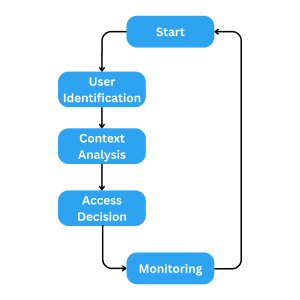
Visualizing Continuous Access Evaluation Process
The Continuous Access Evaluation process involves ongoing assessment of user permissions and access rights to ensure security and compliance. By visualizing this process, organizations can better understand and manage access controls in real-time. This proactive approach allows for timely adjustments to access levels, reducing the risk of unauthorized access. Furthermore, it enhances accountability by providing clear insights into who has access to what resources at any given moment. This flowchart illustrates how Continuous Access Evaluation works:
Benefits of Continuous Access Evaluation
-
- Enhanced Security Through Immediate Response
The ability of CAE to immediately repair security flaws is one of its best features. In conventional models, access tokens would remain valid until they expired if a user’s credentials were stolen or an employee departed the company, providing a risky window of opportunity for attackers. Tokens are canceled with CAE as soon as a crucial event takes place, like a password reset, account disablement, or an odd attempt to log in. This significantly lowers the risk of unauthorised access to sensitive systems and data by ensuring that access reflects the organisation’s security posture in real time. - Improved User Experience Without Sacrificing Protection
User convenience is frequently sacrificed for strong security, but CAE alters that relationship. Employees experience fewer disruptions, and verification prompts during their regular workdays when longer token durations are supported. At the same time, their sessions are constantly assessed in comparison to actual security scenarios. Access is promptly reevaluated if something changes, such as a dangerous login or a switch to a non-compliant device. As a result, employees have a more seamless and effective experience without sacrificing the security measures that organizations depend on. - Operational Efficiency and Reduced Manual Workload
Access management has always required significant administrative overhead for IT and security personnel, such as manually terminating connections or depending on transient tokens that irritate users. A large portion of this load is automated by CAE. Teams no longer need to continuously step in to enforce access controls because access is dynamically modified based on occurrences. The system itself manages regular enforcement in a dependable and consistent manner, freeing up IT personnel to concentrate on higher-value strategic activities. This lessens the burden on resources and the possibility of human error in access rights management over time. - Future-Ready Identity Protection
According to the Microsoft Digital Defense Report, there are 600 million cyberattacks worldwide every day. Identity security is rapidly evolving, and attackers are increasingly using tokens and session hijacking as access points. The goal of CAE is to prepare organizations for tomorrow’s threats while addressing today’s. CAE is well-positioned to take advantage of developments in AI-driven anomaly detection, richer contextual signals, and wider third-party application integration because it is based on an event-driven approach and is closely linked with Microsoft Entra. This guarantees that organizations implementing CAE will stay ahead of new threats as the threat landscape becomes more complex, safeguarding their personnel and data.
- Enhanced Security Through Immediate Response
Implementing Continuous Access Evaluation in the Enterprise
Adopting Continuous Access Evaluation (CAE) is not a simple “switch on” exercise it requires a structured, well-planned rollout to ensure the organisation gains the full security benefits without introducing unnecessary friction for users. Successful implementation comes down to readiness assessment, phased deployment, and continuous optimisation.
-
- Evaluate Readiness
The first step is understanding your current environment’s compatibility with CAE. Not every application or network configuration supports real-time token evaluation out of the box. IT teams should confirm that client applications, browsers, and network setups (such as VPNs and proxy servers) are CAE-capable. This initial assessment avoids disruptions later in the rollout and ensures critical services can take advantage of CAE’s protections. - Phased Rollout for Controlled Adoption
Rather than enabling CAE organisation-wide immediately, a measured approach works best. Start with Microsoft-native services that already support CAE, such as Exchange Online, Teams, and SharePoint. These core applications are widely used across most enterprises, making them ideal candidates to validate CAE functionality. During this stage, closely monitor user behaviour, sign-in patterns, and potential disruptions. Lessons learned here can then guide adjustments to Conditional Access policies before expanding CAE to third-party or line-of-business applications. This reduces risk and ensures a smoother adoption across the enterprise. - Monitor, Refine, and Optimise
Implementation is not the end of the process CAE must be actively monitored and fine-tuned over time. Using Microsoft Entra logs and reporting tools, IT teams can track how CAE is performing, identify anomalies, and assess the impact on user experience. Conditional Access policies may need adjustment to strike the right balance between security and productivity. For example, fine-tuning location-based rules or device compliance checks can help reduce false positives while still enforcing strict security requirements. The goal is to create an adaptive security model that strengthens protection without slowing down business operations. - A Strategic Investment in Security and Productivity
When implemented thoughtfully, CAE becomes more than just a security feature it’s a cornerstone of modern identity protection. By reducing manual overhead, improving responsiveness to threats, and aligning with future-ready security models, CAE enables organisations to safeguard their data while empowering employees to work seamlessly. It represents a strategic investment that benefits both IT operations and executive priorities, striking the right balance between control and flexibility.
- Evaluate Readiness
Implementing Continuous Access Evaluation (CAE) in an enterprise requires careful planning, structured execution, and ongoing monitoring to ensure both security and user productivity. The process begins with clearly defining objectives, such as reducing token-abuse risks, protecting sensitive data, and enforcing device or location-based policies. Once goals are aligned, organisations should assess readiness by confirming that client applications, browsers, and network configurations such as VPNs and proxies support CAE, and that modern authentication is fully enabled across the environment.
Next, Conditional Access policies should be reviewed and simplified to ensure they reflect the organisation’s security posture. Policies for MFA, device compliance, trusted locations, and risk signals form the foundation for real-time access evaluation. Safety nets, such as break-glass accounts and rollback plans, should be prepared to prevent accidental lockouts during implementation. Organisations are advised to adopt a phased rollout, starting with a small pilot group using Microsoft-native services like Exchange Online, Teams, and SharePoint. During this phase, typical scenarios including account disablement, password resets, device non-compliance, or unusual sign-ins should be tested to validate token revocation behaviour and user experience.
Monitoring is critical throughout the rollout. Logs and telemetry from Microsoft Entra and connected applications should be used to tune policies, reduce false positives, and optimise re-authentication prompts. Once the pilot demonstrates stable behaviour, CAE can be gradually expanded across additional users, applications, and eventually third-party or custom solutions, ensuring policies are adjusted to maintain both security and operational efficiency. Service desk teams and managers should be trained on expected user experiences and common CAE-triggered events, supported by clear runbooks for incident response. Finally, continuous measurement of revocation speed, user impact, policy coverage, and security efficacy ensures CAE remains effective, while regular reviews of exceptions and comprehensive documentation safeguard consistency and audit readiness.
Why Continuous Access Evaluation Changes the Game?
Let’s consider how CAE changes the way we handle access under common, high-risk conditions. Take the situation where an employee leaves the organisation. In traditional token management, their access tokens could remain valid for a set period often up to an hour after termination. This creates a gap in security that could potentially be exploited. With CAE, that window effectively disappears. Tokens are continuously evaluated, and as soon as an account is deactivated or credentials are changed, access is revoked within minutes. This ensures that sensitive resources are protected immediately, without requiring manual intervention from IT teams.
Another scenario to consider involves unusual or unexpected sign-ins. For instance, if a token was issued in one location, such as Sydney, and then used from a geographically distant or unexpected location, traditional access models would still allow the session to continue until the token expired. CAE introduces dynamic evaluation in these cases, triggering a re-authentication request or denying access entirely if the activity appears suspicious. This kind of near-real-time response allows organisations to act decisively, reducing the risk of unauthorised access while maintaining continuity for legitimate users.
In both of these situations, CAE transforms access management from a reactive, time-bound process into a proactive, event-driven model. It gives IT teams confidence that policies are enforced immediately, allows directors and operations managers to reduce operational risk, and helps ensure that end users experience minimal disruption while staying secure.
A Strategic Lever for Modern Security
Continuous Access Evaluation isn’t just a technical feature it’s a game-changing approach to protecting your organisation’s most critical assets. By shifting from static, time-limited token validation to real-time, event-driven enforcement, CAE closes gaps that traditional access controls leave exposed, strengthens compliance, and gives your teams confidence that operations remain secure even as threats evolve.
For enterprise leaders, security teams, and IT experts alike, the message is clear: the time to act is now. Starting with Microsoft-native services such as Exchange Online, Teams, and SharePoint, CAE provides a foundation for an agile, real-time access management strategy that grows with your organisation and adapts to emerging risks.
In today’s digital world, where a single second can be the difference between a blocked intrusion and a serious breach, CAE ensures the right people have the right access every time, everywhere. Plex IT can guide your organisation through assessing readiness, planning deployment, and implementing CAE so that security becomes not just a safeguard, but a strategic advantage.
Continuous Access Evaluation is no longer a feature; it’s the frontline of modern cloud security.
Recent Posts

The MSP Model in 2026: A Smarter Way to Secure, Support, and Strengthen Your Business

Building Cyber Resilience in 2026: Protecting ICT Systems and Business Communications

Ways to Stay Safe From Cyber Attacks This Holiday Season

The Great Infrastructure Debate: Cloud vs On-Premise Infrastructure

Phishing-Resistant Authentication: The Next Evolution in Security

Azure Arc Multi-Cloud Connector: Breaking Down Cloud Barriers & Mastering Integration

Authentication Flows: When Convenience Meets Security Risk

Driving Efficiency at Scale: Zero-Touch Deployment Powered by Intune & Autopilot

Unlocking Business Potential Through AI Agents & Copilot Studio

Mastering Cross-Tenant Access in Azure AD: Security Meets Seamless Collaboration


0 Comments